AI Agent Handoff: 5 Ways to Automate Task Handoffs in 2026
AI agent handoff is how one AI passes work to another without you copy-pasting between chat windows. Most people get it wrong and end up babysitting every step. Here are 5 patterns that actually work in 2026, with the exact tools I use.
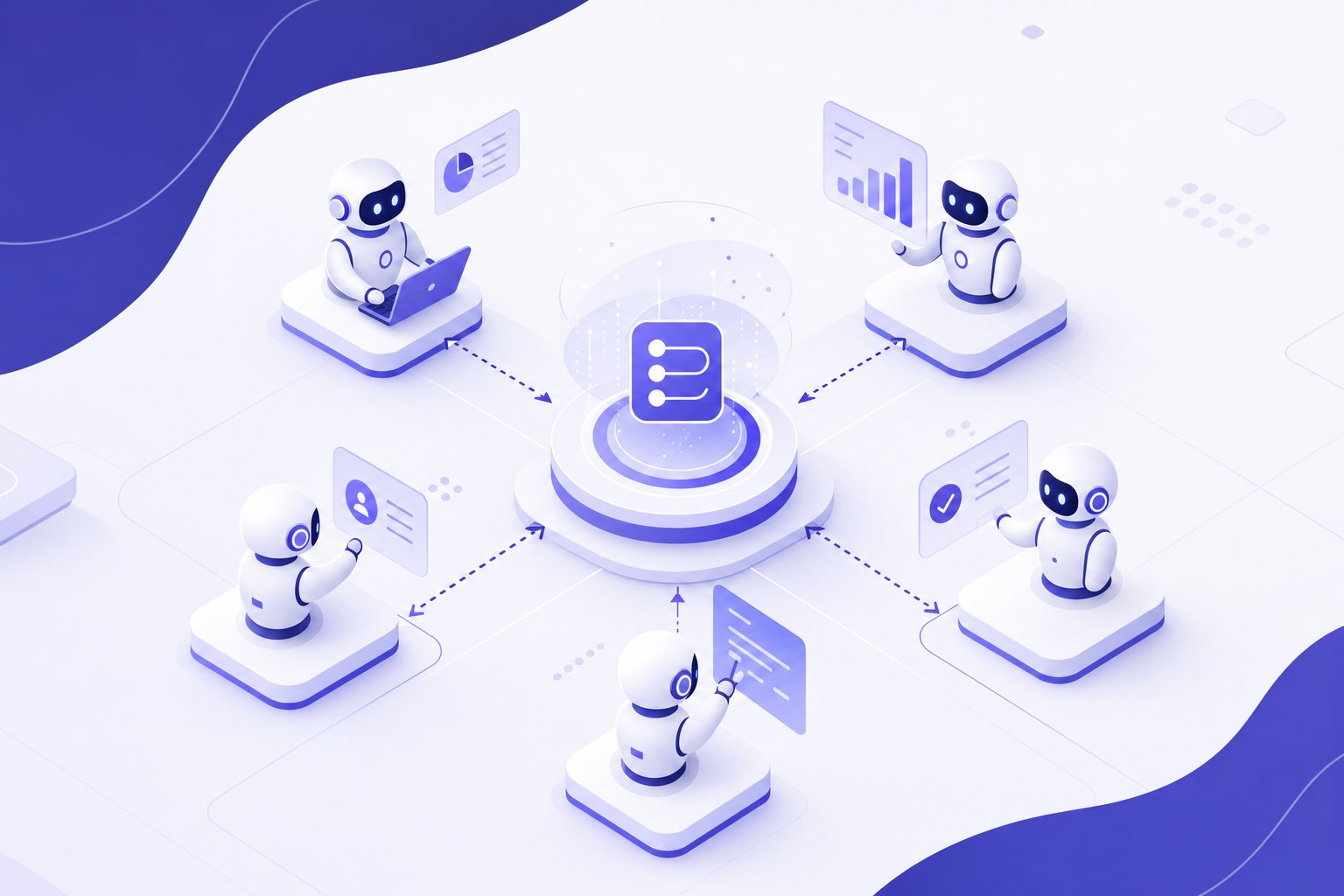
🤝 What Is an AI Agent Handoff, Really?
An AI agent handoff is the moment one AI agent finishes its part of a job and passes the result, plus enough context, to another agent that continues the work. Think of a relay race: the baton is the data, and a dropped baton means the second runner starts from zero.
Here's a concrete example. Agent A researches a topic and produces notes. Agent B turns those notes into a draft. Agent C edits the draft and formats it for publishing. If you're doing this today by copy-pasting between ChatGPT tabs, you ARE the handoff mechanism, and you're the bottleneck.
Automating the handoff means the output of one agent becomes the input of the next without you in the middle. This is what tools like Claude Code's subagents, OpenAI Codex tasks, and MCP (Model Context Protocol) servers were built for.
Why does this matter in 2026? Because single-agent workflows hit a ceiling fast. One model with one context window can't research, write, fact-check, and format a large project in a single pass without quality degrading. Splitting work across specialized agents, each with a clean context and a narrow job, consistently produces better results. But only if the handoff between them doesn't lose information.
⚠️ Why Most Multi-Agent Setups Fail
Before I show you what works, let's name the three failure modes I see (and have personally caused) most often.
Failure #1: Context evaporation. Agent A knows why a decision was made. Agent B only receives the decision itself. Three handoffs later, the final agent is working from a summary of a summary, and the output drifts away from your original intent. The fix is passing structured context, not just results, but constraints and reasoning.
Failure #2: Format roulette. Agent A returns its output as free-form prose. Sometimes it's a list, sometimes paragraphs, sometimes it adds a friendly preamble like 'Sure! Here's what I found...'. Agent B then has to guess how to parse it, and guessing fails silently. This is why every serious agent pipeline uses structured output, usually JSON with a defined schema, at each handoff point.
Failure #3: No verification gate. If Agent A hallucinates a fact and hands it off, Agent B treats it as ground truth and builds on it. Errors compound at every hop. Mature pipelines insert a checkpoint, either a verification agent or a human review, before expensive downstream work begins.
All three failures share a root cause: treating the handoff as an afterthought instead of designing it first. The handoff IS the architecture.
The 'summary of a summary' problem
Every time an agent compresses context to pass it along, detail is lost. After 2-3 hops, critical constraints ('the client hates exclamation points', 'budget is $500 max') can vanish entirely. The practical fix: keep a shared source-of-truth document (a brief, a spec file, or a shared memory store) that every agent reads directly, instead of relying on each agent to re-transmit the full context.
🔀 5 Handoff Patterns That Actually Work
There are five basic patterns for passing work between AI agents. Almost every real automation is one of these, or a combination.
1. Sequential pipeline. Agent A → Agent B → Agent C, each doing one step. Best for linear workflows like research → draft → edit. Simple to build and debug, but slow, since nothing runs in parallel.
2. Orchestrator + workers. One 'manager' agent breaks the job into subtasks, dispatches them to worker agents (often in parallel), and assembles the results. This is how Claude Code's subagent system works: the main agent delegates to specialized subagents and receives only their final summaries back, keeping its own context clean.
3. File-based handoff. Agent A writes its output to a file (JSON, Markdown, CSV); Agent B reads that file as its starting point. Low-tech, incredibly robust, and easy to inspect when something breaks. This is the pattern I recommend beginners start with, you can literally open the handoff file and see exactly what was passed.
4. Shared workspace via MCP. Agents connect to the same external systems, a database, Notion, GitHub, Google Drive, through MCP servers. Instead of passing data directly, Agent A updates the shared system and Agent B picks up from there. This is how handoffs work when the agents run at different times or on different platforms.
5. Event-driven triggers. Agent A finishing becomes an event (a webhook, a new file, a completed task) that automatically launches Agent B. Platforms like n8n, Make, and Zapier handle the plumbing; scheduled agents in Claude Code can do it natively. This is where 'handoff' becomes true automation, nothing waits for you.
Here's how they compare:
| Pattern | Difficulty | Best for | Main risk |
|---|---|---|---|
| Sequential pipeline | Easy | Linear workflows (research → write → edit) | Slow; errors compound down the chain |
| Orchestrator + workers | Medium | Big tasks that split into parallel parts | Manager agent gets a bad summary back |
| File-based handoff | Easy | Beginners; anything you want to inspect | Stale files if a step silently fails |
| Shared workspace (MCP) | Medium | Cross-tool workflows (Notion, GitHub, Drive) | Permissions and auth setup |
| Event-driven triggers | Harder | Fully hands-off recurring automation | Silent failures while you're not watching |
🛠️ The Tools I Actually Use for Agent Handoffs
You don't need a custom framework to do this. Here's the stack I use, with current versions so you can find exactly what I'm describing.
Claude Code (running Claude Sonnet 4.6 or Opus 4.8) is my orchestration layer. Its subagent feature is a built-in handoff system: the main agent spawns specialized subagents, each with a fresh context window, and gets structured results back. You can define custom subagents (a 'researcher', a 'reviewer', a 'writer') in plain Markdown files, and Claude Code routes work to them automatically. Its Workflow feature goes further, a script that fans out to many agents in parallel with deterministic control flow.
The Anthropic API is what you graduate to when you want handoffs inside your own code. The key feature for handoffs is tool use with JSON schemas: you force each agent to return output in an exact structure, so the next agent (or your code) never has to parse free-form prose. Structured outputs are the single biggest reliability upgrade for any pipeline.
OpenAI Codex covers a similar role on the OpenAI side: you assign it a coding task, it works asynchronously in its own environment, and hands back a completed diff. The handoff pattern here is 'delegate and review', you're Agent B, reviewing what the machine Agent A produced.
MCP servers are the connective tissue. Model Context Protocol is an open standard (originated by Anthropic, now adopted across the industry) that lets agents talk to external tools, Gmail, Google Drive, Notion, Slack, GitHub, through one consistent interface. For handoffs, MCP means Agent A can write results into a real system that Agent B reads later, even if the two agents run on different platforms.
For no-code users: n8n, Make, and Zapier all support AI steps now. You can chain 'AI node → formatting node → AI node' visually and get a real multi-agent pipeline without writing code.
Which one should a beginner start with?
Start with Claude Code subagents if you're comfortable in a terminal, or Zapier/Make AI steps if you're not. Both give you working handoffs in under an hour. Move to the Anthropic API with structured outputs only when you need the pipeline embedded in your own product or scripts.
📋 Real Example: A 3-Agent Content Pipeline
Let me make this concrete with a pipeline I run for blog content. Three agents, file-based handoffs, one shared brief.
Step 1, the shared brief. Before any agent runs, I write a short brief file: topic, audience, tone, constraints, and things to avoid. Every agent reads this file directly. This kills the 'summary of a summary' problem, because context never has to survive a relay, it lives in one place.
Step 2, the researcher agent. It searches, reads sources, and writes findings to research.json with a fixed schema: claims, sources, and a confidence level for each claim. Structured output means the next agent never has to interpret prose.
Step 3, the writer agent. It reads the brief plus research.json and produces draft.md. It's explicitly told: 'Only use claims from research.json. If a claim has low confidence, hedge or omit it.' That single instruction is a verification gate baked into the handoff.
Step 4, the editor agent. It reads the brief and draft.md, checks the draft against the original constraints, fixes tone, and outputs the final file. Because it re-reads the brief (not a compressed version of it), it catches drift the writer introduced.
The template below is the handoff contract I give each agent. Adapt the fields to your own workflow, the structure matters more than the specifics.
HANDOFF CONTRACT (paste into each agent's instructions) You are one agent in a pipeline. Follow these rules: 1. READ FIRST: brief.md (the source of truth) + the output file from the previous agent. 2. YOUR JOB: [one sentence, e.g., 'Turn research.json into a 1,500-word draft.'] 3. OUTPUT FORMAT: Write ONLY to [filename], in this structure: [define fields/sections]. 4. DO NOT: add commentary, greetings, or explanations outside the output file. 5. IF BLOCKED: If the input is missing or contradicts brief.md, write a file named BLOCKED.md explaining the problem instead of guessing. 6. CONFIDENCE: Flag anything you are unsure about in a 'notes' field, never present a guess as fact.
✅ Your Pre-Automation Checklist
Before you wire agents together and walk away, run through this checklist. Every item comes from a mistake I've made at least once.
The theme across all of these: automate the handoff only after the manual version works. Run your pipeline by hand, you playing courier between agents, at least twice. If the manual version produces bad output, automation will just produce bad output faster.
And design for failure visibility from day one. The worst multi-agent bug isn't a crash, it's a pipeline that keeps running while quietly producing garbage. A crash gets fixed; silent drift gets published.
- ✔Each agent has ONE clearly defined job (if you can't state it in a sentence, split it)
- ✔Every handoff uses a defined format (JSON schema or file template, never free-form prose)
- ✔A shared brief/spec exists that every agent reads directly
- ✔You ran the whole pipeline manually at least twice before automating
- ✔There's a verification gate before the most expensive or public step
- ✔Agents write 'BLOCKED' status instead of guessing when inputs are missing
- ✔You can inspect every intermediate output (files beat invisible memory)
- ✔A human reviews the final output before it goes anywhere public
🔭 Where Agent Handoffs Are Heading Next
Two shifts are worth watching, because they change what you should build today.
First, handoffs are becoming native features instead of duct tape. A year ago, chaining agents meant custom scripts and prayer. Now Claude Code ships subagents, workflows, background tasks, and scheduled agents as first-class features, and MCP gives agents a standard way to share tools and data. The trend is clear: the platforms are absorbing the plumbing. Build your pipelines on these native primitives rather than fragile custom glue, and they'll get better as the platforms improve.
Second, cross-platform handoffs are becoming realistic. Because MCP is an open standard adopted well beyond Anthropic, an agent on one platform can increasingly hand work to systems and agents elsewhere through shared MCP servers. Your 'team' of agents won't all need to live in one vendor's ecosystem.
What does this mean practically? Don't over-invest in custom orchestration code that a platform feature will replace in six months. Do invest in the parts that transfer everywhere: clear task definitions, structured handoff formats, shared briefs, and verification gates. Those are the skills, and they'll outlast any specific tool version.
❓ Frequently Asked Questions
What does 'handoff' mean in AI agents?
A handoff is when one AI agent passes its completed work, plus the context needed to continue, to another agent. It can be as simple as one agent writing a file that the next agent reads, or as automated as an orchestrator dispatching subtasks to worker agents in parallel. The quality of the handoff (structured format, preserved context) usually matters more than the quality of the individual agents.
Do I need to know how to code to connect AI agents?
No. Zapier, Make, and n8n let you chain AI steps visually with no code, and Claude Code's subagents are defined in plain Markdown files. Coding becomes useful when you want handoffs embedded in your own product, that's when you'd use the Anthropic API with structured outputs. Start no-code, graduate when you hit a wall.
What is MCP and why does it matter for agent handoffs?
MCP (Model Context Protocol) is an open standard that lets AI agents connect to external tools, Gmail, Notion, GitHub, databases, through one consistent interface. For handoffs, it means Agent A can write results into a shared system that Agent B reads later, even across different platforms. It was originated by Anthropic and is now adopted widely across the industry.
Why do multi-agent pipelines produce worse results than a single agent sometimes?
Usually because of the handoffs, not the agents. Context gets compressed at every hop (the 'summary of a summary' problem), unstructured outputs get misread by the next agent, and errors compound without verification gates. A single agent avoids all three problems, so a multi-agent setup only wins when each handoff is structured, context lives in a shared brief, and there's a checkpoint before expensive steps.
Which is better for agent handoffs: Claude Code or OpenAI Codex?
They solve different problems. Claude Code (with Sonnet 4.6 or Opus 4.8) is a full orchestration environment, subagents, workflows, MCP connections, scheduled tasks, so it's better for building multi-agent pipelines. OpenAI Codex is a delegate-and-review tool for coding tasks specifically. Many developers use both: Claude Code as the orchestrator, with other tools as workers.
🏁 Final Thoughts
Three things to take away. One: the handoff is the architecture, most multi-agent failures are dropped context, unstructured outputs, or missing verification gates, not weak models. Two: start with the simplest pattern that works, a file-based handoff with a shared brief will outperform a fancy orchestrator you can't debug. Three: invest in transferable skills (clear task definitions, structured formats, verification gates) rather than platform-specific glue code. Your next action: pick one repetitive two-step task you do with AI today, split it into two agents with a written handoff contract, and run it manually twice before automating. If this guide helped, subscribe to Agents at Work for more hands-on agent automation guides, and drop a comment with the first pipeline you're going to build. I read every one.
Last updated: July 06, 2026 · Keyword: AI agent handoff · Agents at Work


Comments
Post a Comment