AWS Agentic Vision Explained: Bedrock + MCP in 2026
AWS just published a guide to 'agentic vision' using Amazon Bedrock and MCP servers. Sounds like jargon? Here's what it actually means for you.
📰 What Happened: AWS Shows How to Give AI Agents Eyes
In July 2026, Amazon Web Services published a technical walkthrough on its blog titled 'Agentic vision: Building visual intelligence with Amazon Bedrock and MCP servers.' It isn't a new product launch, it's AWS showing developers a recipe for combining two things that already exist: vision-capable AI models hosted on Amazon Bedrock (AWS's managed service for foundation models like Anthropic's Claude family and Amazon's own Nova models) and MCP servers, which are small connector programs built on the Model Context Protocol.
The core idea is simple to state: instead of an AI that just describes a picture when you upload one, you get an AI agent that can look at images as part of a larger job, fetching them, inspecting them, extracting information, and then taking the next step on its own, like updating a spreadsheet or flagging a problem.
MCP, if you haven't run into it yet, is an open standard originally released by Anthropic in late 2024. Think of it as a universal plug: any tool that speaks MCP (a photo library, a database, an image-analysis service) can be plugged into any AI agent that speaks it too. AWS's post shows how to wire vision tools into Bedrock-powered agents through that plug.
The one-sentence version
AWS published a blueprint for building AI agents that don't just read and write text, they can see images, understand what's in them, and act on what they find, using Bedrock models plus MCP connectors.
👁️ Vision AI vs. Agentic Vision: What's Actually New Here?
You might be thinking: 'AI could already see images. I've dropped screenshots into ChatGPT and Claude for years.' True, models like GPT-4o, Gemini, and Claude have handled images for a while. The shift AWS is describing is about *who does the work around* the seeing.
Classic vision AI is a one-shot exchange: you upload a photo, the model describes it, done. Agentic vision puts that same capability inside a loop. The agent decides it needs to look at something, goes and gets the image itself (from your cloud storage, a camera feed, a product catalog), analyzes it, and then does something with the answer, no human ferrying screenshots back and forth.
The MCP server part is what makes this practical rather than a custom engineering project. Each MCP server exposes one capability, 'list images in this folder,' 'run object detection,' 'read this document scan', in a standard format the agent understands. Developers can mix and match connectors instead of hand-coding every integration.
| Classic vision AI (chatbot) | Agentic vision (Bedrock + MCP) | |
|---|---|---|
| Who supplies the image | You upload it manually | The agent fetches it via an MCP connector |
| Output | A description or answer in chat | An action: update a record, send an alert, file a report |
| Scale | One image at a time | Hundreds of images in a batch, unattended |
| Setup | None, just chat | A developer wires up Bedrock + MCP servers once |
💼 Why It Matters for Solopreneurs and Knowledge Workers
If you run a small business, a lot of your most tedious work is visual: checking product photos before they go live, pulling numbers out of scanned invoices and receipts, reviewing user-submitted images, comparing screenshots of competitor pages. Until now, 'AI automation' mostly meant text, email drafts, summaries, spreadsheets. This pattern extends automation to anything you can point a camera or scanner at.
Concretely, the kinds of workflows this architecture enables: an agent that watches a folder of incoming receipts and logs each one into your bookkeeping tool; an agent that checks every new product image against your listing guidelines (right background, no watermark, correct dimensions) before publishing; an agent that reviews inspection photos from a job site and flags the ones that need human eyes.
The second reason this matters is the standard behind it. Because MCP is open and now supported across the major AI platforms, Anthropic's Claude, OpenAI, Google, and AWS all work with it, tools built as MCP servers aren't locked to one vendor. The no-code and automation tools that solopreneurs actually use (think Zapier-style platforms and AI assistants like Claude) are steadily adopting MCP, which means capabilities that start as AWS developer blueprints tend to show up later as buttons non-developers can click.
The realistic caveat
This particular AWS post is written for developers. If you don't code, you won't be assembling Bedrock agents yourself this week, and that's fine. The value for you today is understanding the direction: 'AI that can see and act' is becoming a standard building block, not a research demo, and it will surface in tools you already use.
🧩 How the Pieces Fit Together (No Code Required)
Here's the architecture in plain English, because it's genuinely worth understanding, this same pattern is behind most of the 'AI agent' news you'll read in 2026.
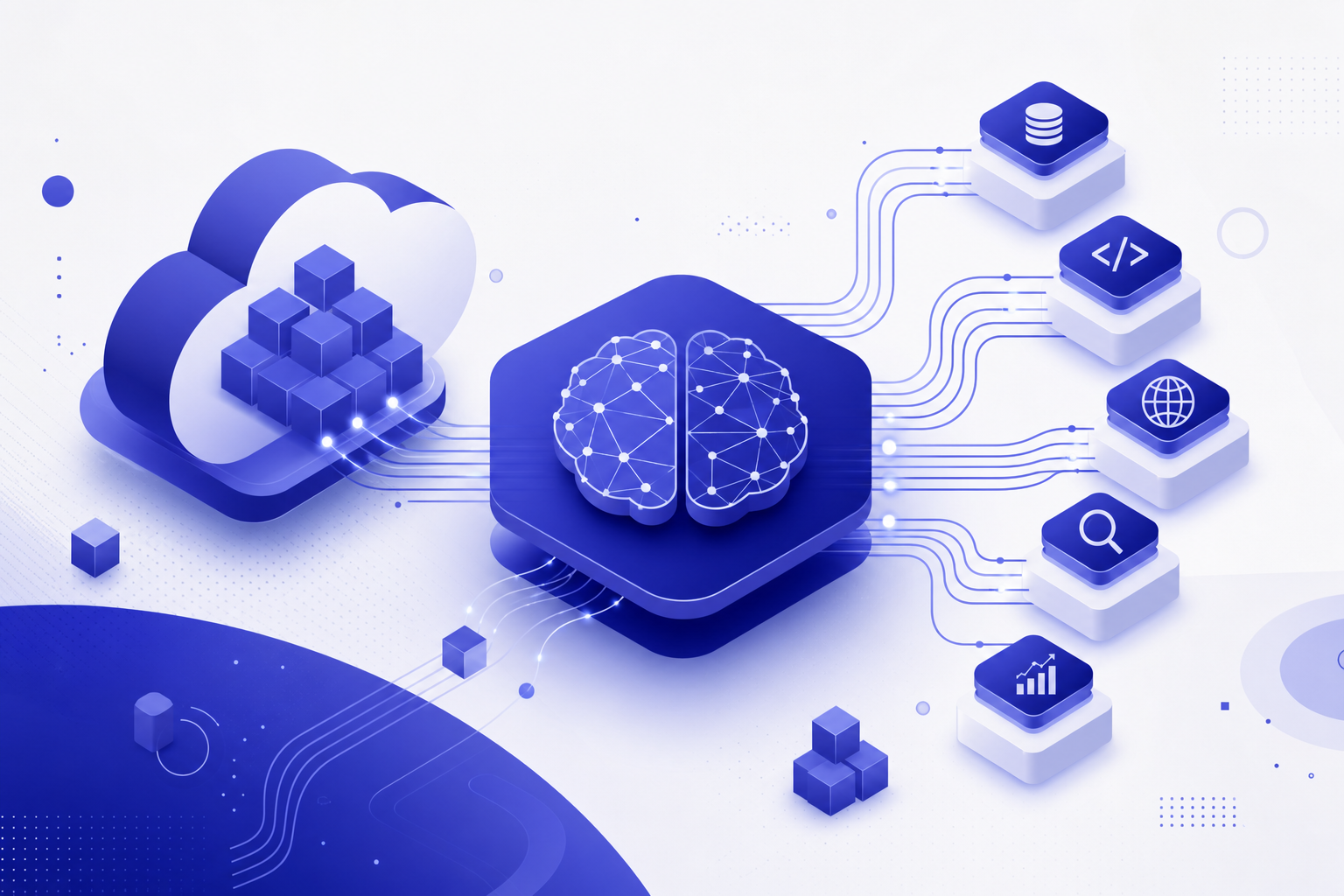
First, the brain: Amazon Bedrock hosts vision-capable foundation models, including Anthropic's Claude models (the current flagship line includes Claude Sonnet 4.6) and Amazon's Nova family, behind one API. The model does the reasoning: 'What am I looking at? What should I do next?'
Second, the hands and eyes: MCP servers. Each one is a small program that gives the agent a specific ability, retrieving files from storage, running specialized image analysis, writing results to a database. The Model Context Protocol standardizes how the brain talks to these tools, the same way USB standardized how computers talk to accessories.
Third, the loop: an agent framework ties it together. The agent receives a goal ('review today's product photos'), plans steps, calls MCP tools to fetch and inspect images, reasons about what it sees with the Bedrock model, and acts, repeating until the job is done. That loop, running without a human at each step, is what the word 'agentic' means.
📦 THE AGENTIC VISION STACK, TRANSLATED 🧠 Brain, Amazon Bedrock A vision-capable model (e.g., Claude Sonnet 4.6, Amazon Nova) → understands images and decides next steps 🔌 Plugs, MCP servers Standard connectors: fetch images, analyze them, save results → one open standard instead of custom code per tool 🔁 Loop, The agent Goal in → see → think → act → repeat → runs unattended until the job is finished
🚀 How You Can Try It or Act on It Today
Your move depends on whether you write code. If you don't, the fastest way to experience agentic vision *right now* is through an AI assistant that already supports both images and MCP connectors, Claude (claude.ai and Claude Code) is the most direct option, since Anthropic created MCP. Drop in a batch of receipts or product photos and ask for structured output (a table, a checklist of problems), then ask it to connect to a tool you use. That's the same pattern, minus the AWS plumbing.
If you're technical or have a developer on call, the AWS blog post itself is the tutorial: search 'Agentic vision Amazon Bedrock MCP servers' on the AWS Machine Learning Blog. You'll need an AWS account with Bedrock access. Related starting points worth bookmarking: the Model Context Protocol docs at modelcontextprotocol.io, AWS's open-source MCP servers on GitHub (github.com/awslabs/mcp), and Bedrock's agent tooling.
Either way, the highest-leverage action today costs nothing: make a list of your recurring visual chores, every task where you look at an image and then type something as a result. That list is your automation backlog for the next twelve months.
- ✔List 3 recurring tasks where you look at images/scans and act on them
- ✔Non-coders: test the pattern in Claude, upload 5 receipts, ask for a structured expense table
- ✔Coders: read the AWS post on the Machine Learning Blog and browse github.com/awslabs/mcp
- ✔Check if your automation platform (Zapier, Make, n8n) supports MCP connectors yet
- ✔Estimate hours/week spent on visual chores, that's your ROI ceiling for this tech
🔭 The Bigger Picture: 2026 Is the Year Agents Got Senses
Zoom out and this post is one data point in a clear trend line. 2024 was the year of chatbots that could see images in conversation. 2025 was the year of agents, AI that plans and executes multi-step work, and the year MCP went from Anthropic side project to industry standard. 2026 is where the two merge: agents with senses, plugged into real business systems through standard connectors.
For big companies, that means things like automated visual inspection on production lines and claims processing from photos. For the rest of us, it means the gap between 'enterprise AI' and 'tools I can afford' keeps shrinking, because open standards like MCP let the same building blocks flow downmarket fast.
The practical takeaway isn't 'go learn AWS.' It's that visual work, long considered automation-proof because 'a human has to look at it', is now squarely on the automation roadmap. The solopreneurs who benefit first will be the ones who already know which of their visual tasks are worth handing off.
❓ Frequently Asked Questions
What is an MCP server, in plain English?
MCP (Model Context Protocol) is an open standard, created by Anthropic in 2024, that lets AI models connect to outside tools and data. An MCP server is a small connector program that exposes one capability, like 'read files from this folder' or 'analyze this image', in a format any MCP-compatible AI can use. It's often described as USB for AI: one standard plug instead of a custom cable for every tool.
Do I need an AWS account or coding skills to use agentic vision?
To follow the AWS blueprint itself, yes, it's a developer guide requiring an AWS account with Amazon Bedrock access and some coding. But the underlying pattern (AI that sees images and acts on them) is already usable without code in assistants like Claude, which supports both image understanding and MCP connectors. Expect no-code automation platforms to package this pattern into ready-made features over time.
What's the difference between Amazon Bedrock and models like Claude or Nova?
Amazon Bedrock is the hosting service, not a model. It's AWS's managed platform that gives developers one API to access many foundation models, including Anthropic's Claude family (currently led by Claude Sonnet 4.6 on Bedrock) and Amazon's own Nova models. Bedrock handles the infrastructure, security, and billing; the models do the actual reasoning and image understanding.
🏁 Final Thoughts
The short version: AWS published a developer blueprint showing how to build AI agents that can see, combining vision models on Amazon Bedrock with MCP servers so agents can fetch images, understand them, and act without a human in the loop. It's not a product you buy today, but it's a clear signal: visual busywork (receipts, product photos, inspections, screenshots) is next in line for automation, and the open MCP standard means these capabilities will reach everyday tools fast. Start by listing your own visual chores this week, that list becomes gold as these features roll out. Enjoying these plain-English AI news breakdowns? Subscribe to Agents at Work and drop a comment with the AI headline you'd like decoded next.
Last updated: July 16, 2026 · Keyword: agentic vision Amazon Bedrock MCP · Agents at Work


Comments
Post a Comment