MCP Explained 2026: Why AI's New USB Port Matters to Music
Music Ally just called MCP the USB port of AI, and the label is spreading fast across the music industry. If that headline left you confused, this explainer breaks down what the MCP standard is, why it matters beyond music, and how you can try it today.
📰 What Happened: Music Ally Puts the MCP Standard on the Industry's Radar
Music industry publication Music Ally published an explainer describing the Model Context Protocol, or MCP, as AI's new USB port and laying out what the standard means for the music business. The framing signals something important: MCP has moved beyond developer circles and is now being discussed in mainstream industry trade press, from record labels to distributors.
Quick background for anyone catching up. Anthropic released MCP as an open standard in November 2024. It defines a common way for AI assistants like Claude or ChatGPT to connect to outside tools and data sources: databases, file systems, business software, and web services. Instead of every company building a custom, one-off integration for every AI model, MCP gives both sides a single shared plug. Build one MCP server for your data, and any MCP-compatible AI can use it.
The standard spread quickly. OpenAI announced support in March 2025, and Microsoft and Google followed with their own backing. By 2026, thousands of MCP servers exist for tools ranging from Google Drive and Slack to GitHub and Stripe. When a music trade outlet starts explaining MCP to label executives, it means the plumbing of AI is becoming a business story, not just a tech story.
Why the USB Port Analogy Works
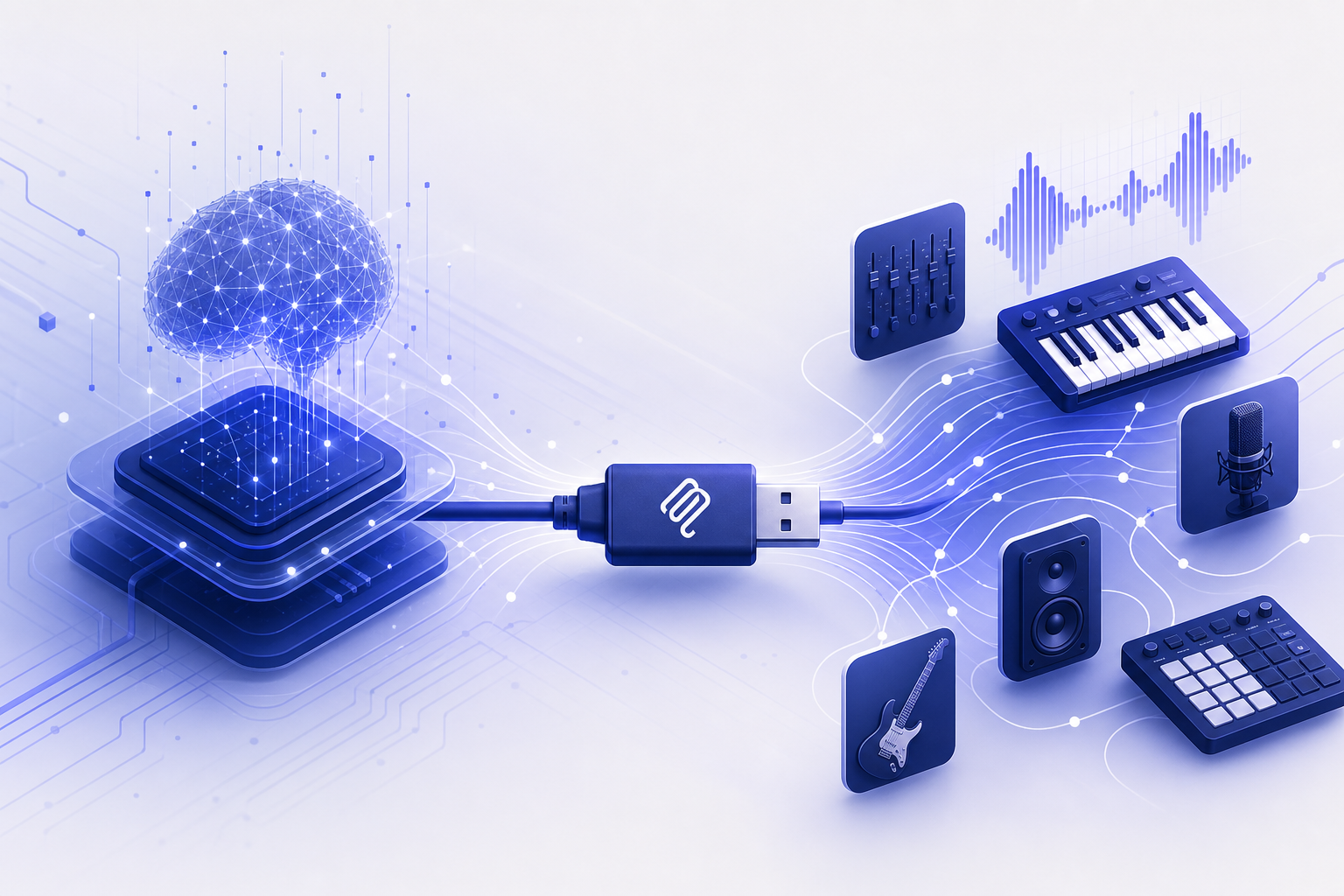
Before USB, every device needed its own special cable and port. Before MCP, every AI integration was a custom job: one connector for Claude, another for ChatGPT, another for Gemini, each maintained separately. MCP standardizes the plug. The AI model is the laptop, your data or software is the device, and MCP is the port they both agree on. That is why Anthropic itself originally described MCP as being like USB-C for AI applications.
🎵 What MCP Could Change Inside the Music Industry
The music business runs on scattered data: streaming numbers on one dashboard, royalty statements in PDFs, catalog metadata in spreadsheets, sync licensing requests in email threads. Today, a label employee or independent artist manually hops between all of these. MCP points toward a different workflow, where an AI assistant connects directly to those systems and answers questions across them.
Picture the practical version. A manager asks an AI assistant, connected through MCP servers to their distributor and analytics tools, something like: which of our tracks grew fastest on playlists last month, and are the royalty payments matching that growth? Without MCP, that question means an afternoon of exporting CSVs. With MCP-connected tools, the assistant can query each source and assemble the answer in one conversation.
For rights holders, the more strategic angle is this: if AI agents become a major way people find and use information, then making your catalog data accessible through an MCP server is like making your website crawlable was in the early days of Google. Companies that expose clean, well-structured data to AI agents, on their own terms and with proper access controls, get to participate in agent-driven workflows. Companies that do not may become invisible to them.
None of this requires the AI to generate music. That is a separate, more controversial topic. MCP is about connecting AI to business data and tools, which is why even AI-skeptical corners of the industry are paying attention.
💡 Why This Matters to You, Even If You Are Not in Music
If you are a solopreneur or knowledge worker, the music industry here is just the case study. The real story is that every industry is about to go through the same shift: AI assistants moving from answering questions to operating your actual tools.
The practical difference is huge. A chatbot without connections can only talk about your business in general terms. An assistant connected through MCP can read your real spreadsheet, check your real calendar, search your real customer records, and draft output based on live data. That is the difference between asking a consultant who has never seen your books and asking one who has them open on the desk.
The comparison below shows how the same everyday tasks change when your AI assistant is connected through MCP versus working from copy-paste alone.
| Task | AI Without MCP | AI With MCP Connections |
|---|---|---|
| Monthly sales or streaming report | You export data, paste it into the chat, then ask for analysis | Assistant queries the connected source and builds the report in one prompt |
| Checking a contract or document | Upload the file manually every session | Assistant searches your connected drive and cites the exact file |
| Managing outreach or pitching | AI drafts text, you copy it into email and CRM yourself | Assistant drafts, logs, and updates records in connected tools |
| Cross-tool questions | Nearly impossible without manual data gathering | Assistant combines data from several connected sources in one answer |
🚀 How to Try MCP Today, No Coding Required
You do not need to be a developer to experience what the fuss is about. The major AI apps have wrapped MCP-style connections in friendly interfaces, usually labeled connectors or apps.
The easiest path is through tools you already pay for. In Claude, powered by models like Claude Sonnet 4.6, open Settings and look for Connectors, where you can link services such as Google Drive, Gmail, Notion, or Slack in a few clicks. In ChatGPT, running models like GPT-4o and its successors, look at connected apps in settings. Google is building similar connectivity around Gemini, including the Gemini 2.0 family and beyond. Under the hood, this is the ecosystem MCP standardized.
Start with one low-stakes connection and one real task. Connect your cloud drive, then ask the assistant to summarize a folder of documents or find every file mentioning a specific client. The moment it pulls a real answer from your real files, the USB port analogy stops being abstract.
If you work in music specifically, watch your existing vendors. Check whether your distributor, analytics provider, or rights platform has announced MCP servers or AI connectors, and ask them about their roadmap if not. Vendor support, not your own technical skill, is what unlocks the workflows described above.
- ✔Open the connectors or apps section in Claude, ChatGPT, or Gemini
- ✔Link one low-stakes tool first, such as a cloud drive folder
- ✔Test with a real question about your real files or data
- ✔Ask your key software vendors whether they offer MCP or AI connectors
- ✔Review what data each connection can access before granting it
⚠️ The Caveats: Security, Accuracy, and Hype
A standard plug means anything can connect, including things that should not. When you grant an AI assistant access to email, files, or business systems, you are trusting both the AI provider and whoever built each connector. Security researchers have flagged risks like prompt injection, where malicious content inside a connected document tricks an agent into misusing its access. The practical rule: only connect tools from providers you trust, and grant the minimum access a task needs.
Accuracy is the second caveat. MCP gives an AI access to real data, but the model can still misread or misstate what it finds. For anything involving money, royalties, or contracts, treat AI output as a fast first draft and verify the numbers against the source before acting.
Finally, keep the hype in perspective. MCP is plumbing. It does not make AI smarter, and it does not settle the music industry's genuinely hard AI disputes over training data, licensing, and AI-generated tracks. What it does is remove the integration bottleneck that kept AI assistants stuck in a chat box. That is a big deal, but it is infrastructure, not magic.
❓ Frequently Asked Questions
What does MCP stand for and who created it?
MCP stands for Model Context Protocol. Anthropic, the company behind Claude, released it as an open standard in November 2024. Because it is open, competitors adopted it too: OpenAI announced support in March 2025, and Microsoft and Google backed it as well, which is what turned it into a de facto industry standard.
Is MCP the same thing as AI-generated music?
No. MCP has nothing to do with generating songs. It is a connection standard that lets AI assistants securely access external tools and data, such as streaming dashboards, catalogs, or document storage. The debates about AI-generated music and training data licensing are separate issues that MCP does not resolve.
Do I need to know how to code to use MCP?
No. Consumer AI apps have wrapped MCP-style connections in simple interfaces, usually called connectors or apps, inside Claude, ChatGPT, and Gemini. You link a service the same way you sign into an app with your Google account. Coding is only needed if you want to build your own MCP server for a custom tool.
Is it safe to connect my business data to an AI through MCP?
It can be, with sensible precautions. Use connectors from official, trusted providers, grant only the access a task actually needs, and avoid connecting highly sensitive systems until you have tested with low-stakes data. Risks like prompt injection are real, so treat AI access permissions the way you treat any third-party app permission.
🏁 Final Thoughts
The headline sounds technical, but the takeaway is simple: MCP is the standard plug that lets AI assistants connect to real tools and real data, and Music Ally covering it means even traditional industries now see that plumbing as strategy. For the music business, MCP hints at a future where catalog, royalty, and streaming data flow into one conversational workspace. For solopreneurs and knowledge workers, the same shift applies to your drive, inbox, and CRM starting today. Try one connector this week with a low-stakes task and see the difference for yourself. If this explainer helped you decode the headline, subscribe to Agents at Work for more plain-English AI news breakdowns, and drop a comment with the next AI headline you want unpacked.
Last updated: July 20, 2026 · Keyword: MCP standard · Agents at Work
Comments
Post a Comment