Meta Ads MCP Now Open to Any App: What It Means in 2026
Meta ads MCP access is now open to any app, according to PPC Land, cutting integration code to zero. Confused by the jargon? Here is what actually happened, why it matters, and how you can act on it today.
📰 What Just Happened: Meta Opened Its Ads MCP to Everyone
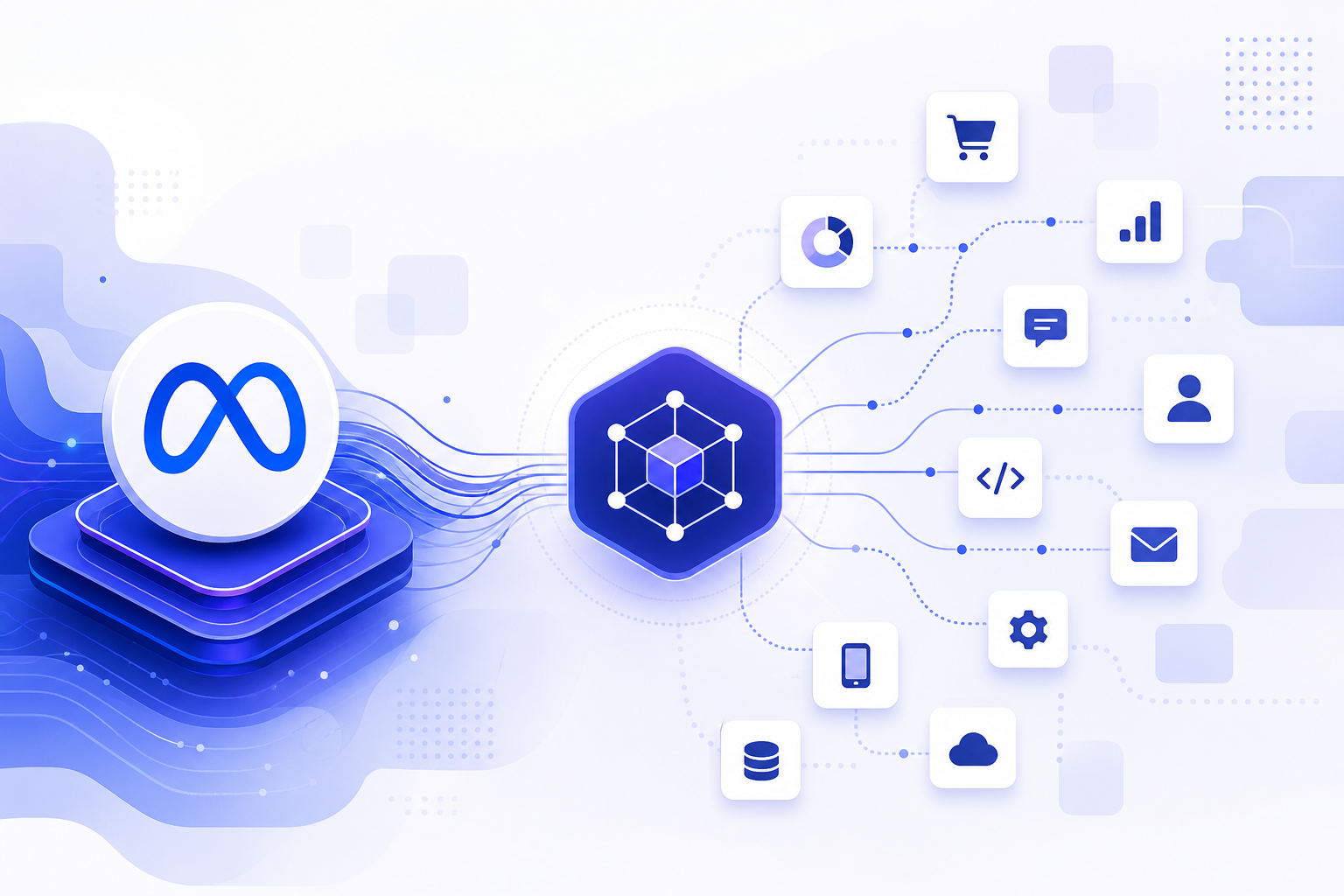
According to a report from PPC Land, Meta has opened its ads MCP server to any application, removing the requirement to write custom integration code to connect software to Meta's advertising system. In plain terms: tools and AI assistants can now talk to Meta Ads through a standard plug, instead of each developer building their own custom adapter.
MCP stands for Model Context Protocol. It is an open standard that Anthropic introduced in November 2024, and it has since been adopted across the AI industry, including by OpenAI, Google, and Microsoft. Think of it as a universal port, like USB-C, but for connecting AI assistants and apps to outside services such as databases, file systems, and now advertising platforms.
Before this change, connecting an app to Meta's ad platform meant working with the Meta Marketing API: registering a developer app, handling authentication, reading documentation, and writing and maintaining code. The headline's phrase 'cutting integration code to zero' refers to what an MCP server eliminates. The connection logic lives on Meta's side, so a compatible app simply points at the server and starts working.
The key word in the news is 'any app.' AI-powered advertising access on Meta is no longer limited to a small circle of official partners or specific assistants. Any MCP-compatible client can now plug in.
The One-Sentence Version
Meta built a standard socket for its ads platform, and as of this announcement, any AI app can plug into that socket without writing connection code.
🔌 MCP in 60 Seconds: The Plug That Makes AI Useful
If you have never heard of MCP, here is the fastest useful explanation. An AI assistant on its own can only talk. It cannot check your ad account, read your campaign results, or create a draft campaign. To do real work, it needs connections to real systems.
Historically, every one of those connections was custom-built. Connecting Assistant A to Service B required its own code, and connecting Assistant C to the same service required different code. The result was a tangle of one-off integrations that only companies with developers could afford.
MCP replaces that tangle with one standard. A service like Meta runs an MCP 'server' that describes what it can do, such as listing campaigns or pulling performance data. Any MCP 'client,' which includes AI assistants like Claude (currently powered by models such as Claude Sonnet 4.6) and a growing list of apps in the ChatGPT and Gemini ecosystems built around models like GPT-4o and Gemini 2.0, can connect to that server and use those abilities immediately.
This is why the news matters beyond developer circles. Once a major platform exposes an MCP server, the barrier between 'I wish my AI could do this' and 'my AI just did this' drops dramatically.
Why Everyone Adopted the Same Standard
Anthropic released MCP as an open standard rather than a proprietary feature, and rivals adopted it through 2025 because a shared plug benefits every side: services integrate once, apps connect everywhere, and users stop caring which assistant they use to reach a given tool.
💡 Why This Matters If You Run Ads Without a Dev Team
If you are a solopreneur or a small team running Meta ads, this news is aimed squarely at you, even though it sounds like developer news. The practical effect is that ad management capabilities that used to require custom software can now show up inside ordinary AI tools.
Consider what managing Meta ads actually involves: checking performance across campaigns, comparing this week to last week, spotting a creative that stopped working, adjusting budgets, and drafting reports. Today most small advertisers do this by clicking through Meta Ads Manager, exporting spreadsheets, and eyeballing numbers. With an MCP connection, an AI assistant can do the reading and summarizing for you in a conversation: 'How did my campaigns perform this week, and which ad should I pause?'
There is also a competitive effect worth understanding. When integration cost drops to zero, the number of tools that can offer Meta ads features explodes. Small SaaS products, niche agency tools, and even individual builders can now add ad-account features that previously only well-funded platforms could ship. More competition among tools generally means better and cheaper options for you.
The honest caveat: an open connection standard does not make the AI's judgment perfect. An assistant reading your ad account can misread context just as it can in any other task. The sensible pattern in 2026 remains letting AI read, summarize, and draft, while you approve anything that spends money.
⚖️ Before vs After: What Zero Integration Code Changes
The clearest way to see the size of this shift is to compare what connecting to Meta Ads looked like before an open MCP server and what it looks like after. The change is not a minor convenience. It reshapes who can build advertising tools and who can use them.
One row deserves special attention: maintenance. Custom API integrations break when the platform updates, which means someone has to keep fixing them. With MCP, Meta maintains the server side itself, so compatible apps inherit updates instead of chasing them.
| Aspect | Before (Custom API Integration) | After (Open Ads MCP) |
|---|---|---|
| Who can connect | Teams with developers and API approval | Any MCP-compatible app |
| Code required | Custom integration code per app | Zero, per the PPC Land report |
| Time to connect | Days to weeks of development | Roughly the time it takes to configure a connection |
| Maintenance | Ongoing developer upkeep | Handled on Meta's side of the standard |
| Typical user | Agencies and large ad-tech platforms | Solopreneurs, small tools, AI assistants |
🚀 How to Act on This Today: 5 Practical Steps
You do not need to write code to benefit from this news, but you do need to know where to look. Here is a realistic action plan for a non-developer who wants to try AI-assisted ad management this week.
First, check whether the AI tools you already use support MCP connections or 'connectors.' Claude supports connecting to external tools through MCP, and MCP-compatible clients across the major AI ecosystems are growing monthly. Look in your assistant's settings for a section named connectors, integrations, or tools.
Second, look for Meta's official documentation before trusting any third-party connector. Because MCP connections can read your ad account, only connect through servers you can verify come from Meta or from a vendor you already trust. Treat an ads connection with the same caution as anything that touches your billing.
Third, start with read-only questions. Ask for performance summaries and comparisons before you ever let a tool change budgets or create campaigns. This builds your sense of where the AI is reliable and where it guesses.
- ✔Check if your AI assistant (Claude, ChatGPT, Gemini) supports MCP or connectors in its settings
- ✔Search Meta's official developer site for its ads MCP documentation, not a third-party mirror
- ✔Verify any connector's source before granting access to your ad account
- ✔Start with read-only questions: performance summaries, week-over-week comparisons
- ✔Keep human approval on anything that spends money or edits live campaigns
- ✔Read the original PPC Land article for the technical specifics
🔭 The Bigger Picture: Ad Platforms Are Racing to Be AI-Native
This announcement is one move in a larger pattern that has defined 2025 and 2026: major platforms are rebuilding their interfaces for AI agents, not just for humans with browsers. Meta has been pushing AI deeper into its ads products for years, and opening an MCP server extends that push beyond Meta's own walls.
The strategic logic is straightforward. Advertisers increasingly work through AI assistants, and Meta wants to be the easiest platform for those assistants to operate. Every friction removed between an AI tool and Meta's ad system makes it more likely that budgets flow to Meta rather than to a competitor that is harder to connect to.
For readers of this blog, the takeaway is directional: expect other advertising and business platforms to follow with their own open MCP servers, and expect 'works with your AI assistant' to become a standard checkbox on software you evaluate. The businesses that benefit first will be the ones that learn to delegate routine platform work, like reporting and monitoring, to AI while keeping judgment calls human.
We will keep tracking this shift on Agents at Work as more platforms open their doors to agents.
❓ Frequently Asked Questions
What is MCP in Meta ads?
MCP (Model Context Protocol) is an open standard, introduced by Anthropic in November 2024, that lets AI apps connect to external services through one shared interface. Meta's ads MCP server exposes its advertising platform through this standard, so compatible apps can read and work with ad accounts without custom integration code.
Do I need to be a developer to use the Meta ads MCP?
Not necessarily. The MCP server itself is infrastructure for apps, but the benefit reaches non-developers through the tools they already use. If your AI assistant or marketing tool supports MCP connections, it can connect to Meta ads on your behalf. Your job is configuration and approval, not coding.
Is it safe to connect an AI assistant to my Meta ad account?
It can be, with sensible precautions. Only use connectors verified as coming from Meta or a vendor you trust, grant the minimum access needed, start with read-only reporting tasks, and keep human approval on any action that spends money. Treat the connection like anything else that touches your billing.
Which AI assistants can connect to MCP servers in 2026?
MCP support is broad in 2026. Claude (running models such as Claude Sonnet 4.6) supports MCP connections, and after OpenAI, Google, and Microsoft adopted the standard in 2025, MCP-compatible clients exist across the ChatGPT and Gemini ecosystems as well. Check your specific app's settings for connectors or integrations.
🏁 Final Thoughts
The short version: Meta opened its ads MCP server to any app, which means AI tools can now connect to Meta's advertising platform without custom integration code, according to PPC Land's report. For solopreneurs and small teams, that translates into a coming wave of cheaper, smarter ad tools and the ability to ask your AI assistant real questions about your own ad account. Your move today is simple: check whether your AI tools support MCP, connect through verified sources only, and let AI handle the reading while you handle the deciding. If explainers like this help you keep up with AI news without the jargon, subscribe to Agents at Work and drop a comment with the next headline you want decoded.
Last updated: July 19, 2026 · Keyword: Meta ads MCP · Agents at Work


Comments
Post a Comment