OpenAI & Anthropic Warn of AI Model Copying in 2026: What Happened
OpenAI and Anthropic say Chinese AI labs are using tens of thousands of fake accounts to copy their AI models. Here's what that actually means, why it affects the tools you use every day, and what to do about it.
📰 What Happened: Tens of Thousands of Fake Accounts
According to a report highlighted by Crypto Briefing, OpenAI and Anthropic — the companies behind ChatGPT and Claude — are warning that Chinese AI labs have been creating tens of thousands of fake accounts on their platforms. The goal, they say, isn't to chat with the AI. It's to systematically harvest the models' answers at massive scale.
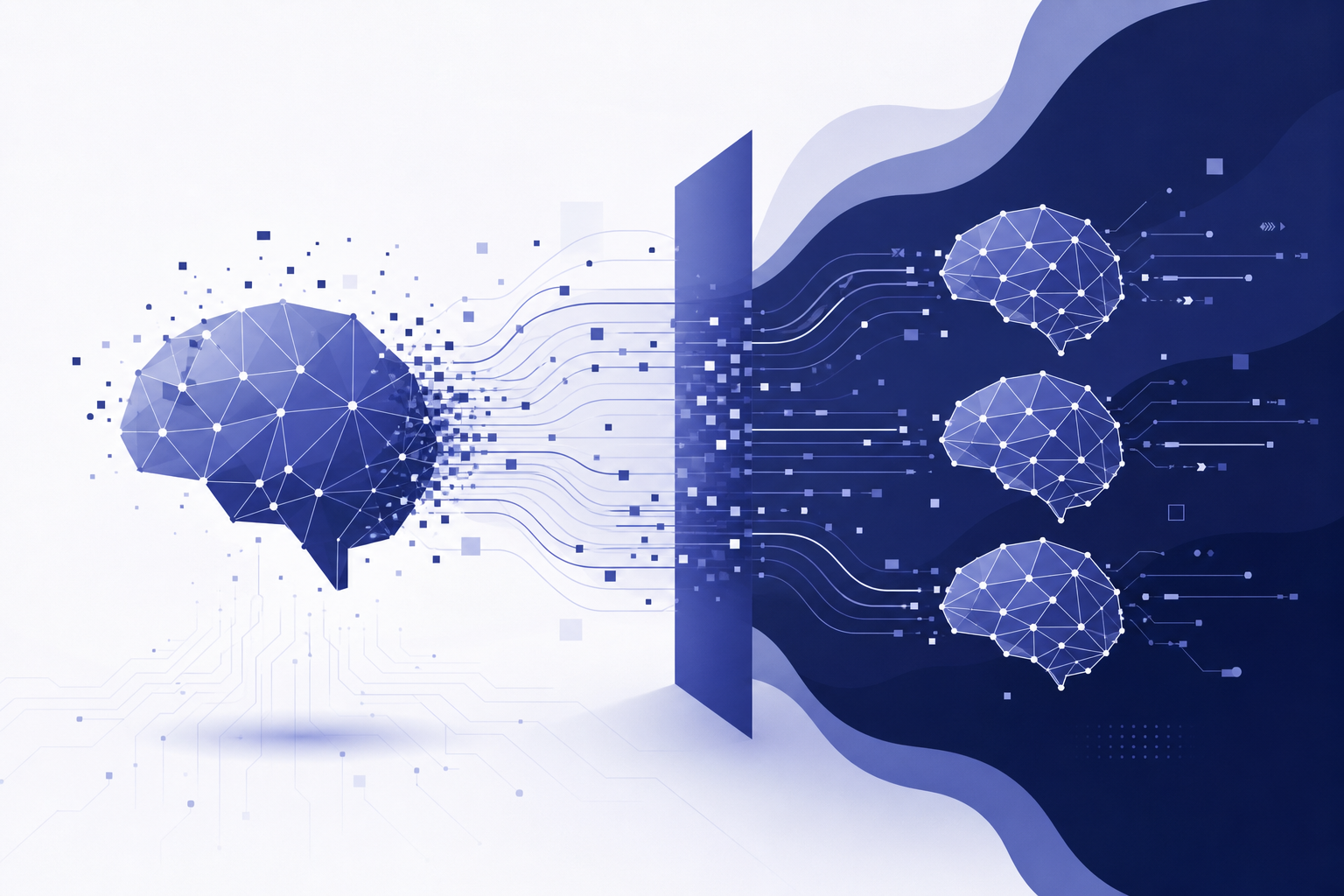
This technique is called 'distillation.' In plain English: you ask a top-tier AI model millions of questions, save all of its answers, and then use those question-and-answer pairs to train your own, cheaper model to imitate it. The copycat model 'learns' from the teacher model's outputs without anyone ever touching the original model's code or weights.
Both companies prohibit this in their terms of service — you're not allowed to use ChatGPT or Claude outputs to build a competing model. The fake accounts exist precisely to get around that rule and around rate limits. When one account gets banned or hits its usage cap, thousands of others keep scraping.
This isn't a brand-new accusation. OpenAI raised similar concerns in early 2025 when DeepSeek's R1 model stunned the industry by matching frontier performance at a fraction of the reported cost. What's new in 2026 is the scale being described — tens of thousands of coordinated accounts — and the fact that both leading US labs are now sounding the alarm together.
What 'Distillation' Means in 30 Seconds
Imagine a student who can't attend a master chef's cooking school, so instead they order every dish on the menu thousands of times, taste each one, and reverse-engineer the recipes. The student never saw the kitchen — but their restaurant ends up serving suspiciously similar food. That's distillation: training a new AI on the outputs of an existing one, instead of on raw data gathered from scratch.
🎯 Why This Matters If You Just Use AI Tools
You might be thinking: 'I'm a solopreneur, not an AI lab. Why should I care about a corporate dispute?' Three reasons, and they all touch your daily workflow.
First, this is why cheap AI models are suddenly so good. If frontier-level intelligence can be copied for a fraction of the original training cost, the price of 'good enough' AI keeps collapsing. That's genuinely great for your budget — but it also means some low-cost models you might plug into your business were potentially built on someone else's homework, which carries legal and reliability question marks.
Second, expect more friction when signing up for AI services. The main defense against fake-account farming is stricter verification: phone numbers, payment cards, identity checks, tighter API rate limits, and more aggressive account bans. If you've noticed AI platforms asking for more verification in 2026 than they did in 2024, this is a big part of why. Legitimate users end up paying the convenience tax for bad actors.
Third, this feeds directly into the US–China AI competition and the regulation that follows it. Both OpenAI and Anthropic have used security arguments like this one to push for export controls and policy support in Washington. The rules that come out of that debate will shape which models are available to you, at what price, and under what terms.
⚖️ The Two Sides: Theft or Fair Game?
It's worth understanding both arguments, because this debate will keep resurfacing every time a cheap model tops a benchmark.
The US labs' position: they spent billions of dollars on compute, research, and safety testing to build these models. Mass-scraping their outputs through fake accounts violates their terms of service, and effectively lets competitors skip the expensive part while free-riding on their investment. Anthropic has also framed this as a national-security issue, arguing that frontier AI capabilities shouldn't leak to strategic rivals.
The counterargument you'll hear: OpenAI and Anthropic trained their own models on vast amounts of internet content — books, articles, code, and websites — largely without asking permission, and are fighting copyright lawsuits over exactly that. Critics call it ironic for them to complain about being copied. Chinese labs, for their part, have generally denied wrongdoing or stayed quiet when distillation accusations surfaced.
There's no neutral referee here. Terms-of-service violations are a contract matter, not clear-cut theft under current law, and enforcing anything across borders is extremely hard. That legal gray zone is exactly why this plays out through account bans, API restrictions, and public warnings rather than courtrooms.
| Question | US Labs' View (OpenAI/Anthropic) | Skeptics' View |
|---|---|---|
| Is distillation via fake accounts wrong? | Yes — it violates terms of service and free-rides on billions in R&D | Gray area — US labs also trained on others' content without permission |
| Is it a security issue? | Yes — frontier capabilities leaking to strategic rivals | Partly framing — it also supports their lobbying goals |
| Can it be stopped? | Slowed with verification, rate limits, and bans | Unlikely — outputs are public-facing by design |
| Who pays the cost? | The labs, in lost competitive edge | Regular users, via stricter signups and limits |
🛡️ How AI Companies Are Fighting Back
Both companies have been rolling out defenses, and you'll feel some of them as a regular user.
On the detection side, the labs monitor for account patterns that look like harvesting: huge volumes of programmatic queries, coordinated signups from the same infrastructure, and usage that looks like dataset generation rather than normal work. OpenAI has previously banned accounts linked to suspected distillation, and Anthropic has restricted access from certain regions and from companies it believes are majority-controlled by Chinese entities.
On the policy side, both labs publish regular threat-intelligence reports about misuse of their platforms and have urged the US government to treat model weights and model outputs as assets worth protecting. Expect this incident to be cited in future policy debates about export controls and AI security standards.
The honest caveat: none of this fully stops distillation. Any model whose answers are publicly accessible can, in principle, be imitated by whoever reads enough of those answers. The labs' realistic goal is to raise the cost and slow the copying — not to make it impossible.
✅ What You Can Do Today: A Practical Checklist
You can't influence a geopolitical AI dispute, but you can position your own work sensibly. The core idea: enjoy the falling prices this competition creates, while keeping your business's sensitive data and critical workflows on providers whose incentives and policies you understand.
If you build anything on top of AI — even simple automations for clients — it's also worth skimming the terms of service of the models you use. The 'don't use outputs to train competing models' clause exists in most major providers' terms, and knowing where the lines are protects you if you ever resell AI-generated work.
Finally, treat this as a reminder that the AI vendor landscape is genuinely unstable. Models get restricted, regions get blocked, prices move. Solopreneurs who keep their prompts, workflows, and data portable — rather than welded to one provider — absorb these shocks much more easily.
- ✔Know where your AI provider is based and what its data policy says before feeding it client or business data
- ✔Read the usage terms of any model you build products or client work on — especially the 'no training competing models' clause
- ✔Keep prompts, workflows, and key data exportable so you can switch providers if one gets restricted or repriced
- ✔Be careful with unusually cheap AI APIs of unclear origin — ask where the model came from before wiring it into your business
- ✔Follow the official OpenAI and Anthropic blogs or threat reports if you want first-hand updates rather than headlines
🔭 What to Watch Next
This story is one chapter in a longer competition, so here are the signals worth watching over the coming months.
Watch for policy responses: the US government has been weighing rules on AI export controls and model security, and warnings like this one are exactly the kind of evidence cited in those debates. Any new rules could change which models are available internationally and how you sign up for them.
Watch the release cycle: every time a Chinese lab releases a strikingly capable open or low-cost model — as DeepSeek did in 2025 — the distillation debate reignites. If accusations come with technical evidence (like a model reproducing another model's distinctive quirks or refusals), that would escalate things significantly.
And watch your own tools: if ChatGPT, Claude, or their APIs tighten signup verification, lower rate limits for new accounts, or restrict access by region, this fight is the likely reason. For most readers of this blog, that's where an abstract headline becomes a concrete Tuesday-morning inconvenience.
❓ Frequently Asked Questions
What is AI model distillation, in simple terms?
Distillation is training a new AI model on the answers of an existing one. Instead of gathering raw training data from scratch, you ask a top model millions of questions, collect its responses, and teach a cheaper model to imitate them. It dramatically cuts the cost of building a capable model, which is why labs guard against it — and why their terms of service ban using outputs to train competitors.
Does this mean ChatGPT or Claude is unsafe for me to use?
No. This dispute is about competitors allegedly copying the models, not about your personal data being breached. Your chats weren't stolen. The practical impact on you is indirect: expect stricter signup verification, tighter rate limits, and possibly regional restrictions as OpenAI and Anthropic harden their platforms against fake-account farming.
Which Chinese AI labs are being accused?
The most prominent name in past distillation disputes is DeepSeek — OpenAI said in early 2025 it had evidence DeepSeek may have used its model outputs, which DeepSeek did not confirm. The 2026 warnings describe a broader pattern involving tens of thousands of fake accounts rather than a single confirmed culprit, and no court has ruled on any of these claims.
Is copying an AI model this way actually illegal?
It's a legal gray zone. Scraping outputs through fake accounts clearly violates the platforms' terms of service, but a terms-of-service breach is a contract issue, not automatically a crime — and enforcement across borders is very difficult. That's why the response so far has been account bans, access restrictions, and public pressure rather than lawsuits with clear outcomes.
🏁 Final Thoughts
Here's the short version: OpenAI and Anthropic say Chinese labs used tens of thousands of fake accounts to mass-harvest their models' answers and train copycat AIs — a technique called distillation that their terms of service forbid but the law struggles to police. For you, the takeaway is practical, not political: cheap capable AI keeps getting cheaper partly because of this dynamic, signup friction on major platforms will keep rising because of it, and the smartest move for a solopreneur is to keep your AI workflows portable and your sensitive data with providers you trust. I'll keep tracking how this story develops — subscribe to Agents at Work for plain-English AI news explainers, and drop a comment below: would you knowingly use a distilled 'copycat' model if it were 10x cheaper?
Last updated: July 12, 2026 · Keyword: OpenAI Anthropic fake accounts AI model copying · Agents at Work


Comments
Post a Comment