Draft Digital Cuts 12 MCP Calls to One Agent in 2026
Draft Digital just cut 12 MCP calls down to one buyer agent to stop token burn. If your AI tools keep hitting usage limits, this 2026 story explains why, and what the fix looks like.
📰 What Happened: 12 Connections Became One Buyer Agent
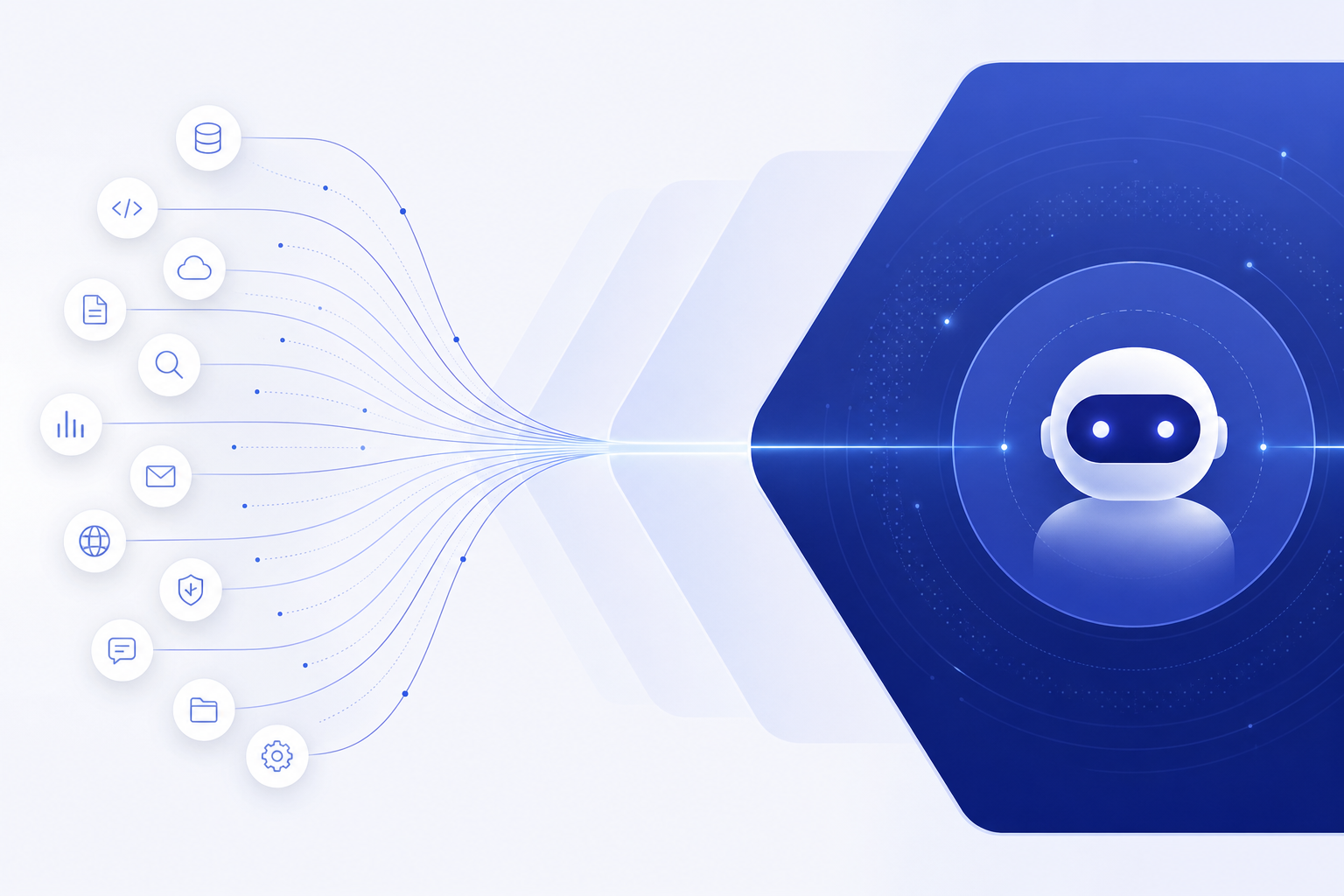
In mid-July 2026, Lars Postmus, owner of the Netherlands-based agencies Draft Digital and Draft Media, published a LinkedIn post that PPC Land picked up as a case study in AI agent design. His team had been building an AI-powered media buying system connected to twelve separate advertising platforms, including Meta, TikTok, Reddit, Google, PubMatic, Triton, BroadSign, Ster, and Ad Alliance. Each platform connection ran through its own MCP call.
MCP stands for Model Context Protocol, an open standard created by Anthropic that lets AI assistants like Claude connect to outside tools and data. Think of it as a universal plug: one side fits the AI, the other side fits a platform like Google Ads or Meta. The problem is that every plug you add costs something. Each of the twelve connections needed its own authentication, its own instructions, and its own context loaded into the AI model. Tokens, the units AI companies bill you for, burned on every single call.
The breaking point was concrete. Four team members hit their Claude usage limits several times in a single workday while building the system. Postmus concluded the issue was not capacity but structure. His answer was an architecture he calls the Draft cockpit: instead of five specialist buying functions each querying twelve endpoints, all channel activity now routes through one consolidated Buyer Agent, with a human strategist at the top keeping control of the plan.
🔀 The Old Model vs the Draft Cockpit
Postmus argued that most agentic advertising setups are just the old agency org chart with AI stapled on. Five human specialist roles became five AI functions, and each still talked to every platform separately. He called this the old model, reskinned. Twelve endpoints queried by five buying functions produced twelve context loads, twelve authentication paths, and twelve rounds of instruction. As he put it, many buyers, many tools, and tokens burn on every call, while strategy quietly fades on the way down.
The Draft cockpit flips that hierarchy. A human strategist sits at the top. Four coordinating agents handle Brand, Performance, Creative, and Data. Below them, a single Buyer Agent executes all channel activity through one unified platform. The five former specialist roles become per-channel Optimization Agents that supply expertise as inputs rather than executing transactions themselves. Postmus summed up the philosophy in one line: humans do the thinking, agents do the lifting.
One honest caveat from the source article: Draft Digital published the architecture and the reasoning, but no comparative token counts or campaign performance benchmarks. This is a design argument backed by a real pain point, not a peer-reviewed cost study.
Why fewer connections means fewer tokens
Every time an AI agent calls a tool, the tool's description, instructions, and returned data all get loaded into the model's context window, and you pay for every token of it. Twelve tools loaded across five agents multiplies that overhead dozens of times per task. One agent with one consolidated interface loads that overhead once. The work done is the same. The billing is not.
| Aspect | Old Model (12 MCP Calls) | Draft Cockpit (1 Buyer Agent) |
|---|---|---|
| Platform connections | 12 separate endpoints | 1 unified agentic ad platform |
| Buying functions | 5 specialists, each calling tools | 1 Buyer Agent executes everything |
| Context loading | 12 separate context loads per cycle | 1 consolidated context load |
| Authentication | 12 separate auth paths | 1 auth path |
| Human role | Diluted across handoffs | Strategist keeps plan control at the top |
| Specialist expertise | Executes transactions directly | Feeds in as Optimization Agent inputs |
💡 Why This Matters Even If You Never Buy an Ad
You might be reading this thinking: I am a solo consultant, not a Dutch media agency. But if you use Claude, ChatGPT, or Gemini with connected tools, you are living the small-scale version of this exact problem. MCP connectors are now everywhere. Claude supports them directly, and OpenAI and Google both adopted MCP support during 2025. Every Notion, Gmail, Slack, or database connector you switch on adds context that gets loaded and billed on your conversations, whether the AI uses that tool or not.
This is why people hit usage limits faster than they expect. Draft Digital's four team members maxing out Claude in one workday is the enterprise version of what happens when a solopreneur wires ten integrations into their assistant and wonders why a simple task ate their daily allowance. The lesson transfers directly: the number of tools your AI can see matters as much as the amount of work it does.
There is also a bigger industry signal here. MCP is the foundation for the Ad Context Protocol, or AdCP, launched on October 15, 2025, which aims to standardize how AI agents buy advertising across the whole industry. An IAB Europe demonstration in April 2026 showed three agents completing a media task in roughly 25 minutes for about 50 euros in token charges. That cost is small against a real media budget, but it shows tokens are becoming a genuine line item in business operations. Companies are now hiring people to think about agent architecture the way they once hired people to think about cloud costs.
⚖️ The Reality Check: Agents Are Not Winning Yet
Before anyone panics about robots taking over media buying, the numbers say the transition is early and messy. A DataBeat report from June 2026, cited in the PPC Land article, found that conventional human programmatic buyers still held a 13.4 percent CPM advantage over AI agents. In plain terms, experienced humans were buying ad space more cheaply than the agents were. Agentic performance sits near parity, not dominance.
Adoption reflects that caution. As of April 2026, only 22.1 percent of agencies had an agentic media buying strategy in place. That is why Draft Digital's post resonated: it is not a victory lap, it is a builder admitting the first version burned money and showing the redesign. That kind of honesty is rare in AI announcements and worth more than a polished case study.
For regular users, the takeaway is balanced. AI agents with tool access are genuinely useful today, but architecture decides whether they save you money or quietly drain it. The winners in this phase are not the people with the most integrations. They are the people with the fewest integrations that still get the job done.
🛠️ How to Apply the One-Agent Lesson Today
You do not need an engineering team to copy the core idea. The principle is: consolidate before you scale. Here is how to run your own version of Draft Digital's cleanup this week, whether you use Claude (Sonnet 4.6 or Opus 4.8), ChatGPT with GPT-4o, or Gemini.
First, audit your connectors. Open your AI assistant's settings and list every connected tool, MCP server, or extension. For each one, ask when you last actually used it. Anything you have not touched in two weeks, disconnect. You can always reconnect in seconds.
Second, match tools to tasks instead of enabling everything everywhere. If a chat session is about writing, it does not need your calendar, your database, and your CRM loaded. Many tools now let you toggle connectors per conversation or per project. Use that.
Third, structure like the cockpit: you are the strategist, and you keep the plan. Give the AI one clear job per session with only the tools that job requires. If you run automations across many services, route them through one hub such as a single orchestrating workflow rather than giving one assistant a dozen direct integrations. The read of the original story is worth your time too: search for the PPC Land article titled Draft Digital cuts 12 MCP calls to one buyer agent, published in July 2026.
- ✔List every tool or MCP connector currently attached to your AI assistant
- ✔Disconnect anything unused in the last two weeks
- ✔Enable connectors per task, not globally
- ✔Give the AI one clear job per session, with you holding the strategy
- ✔If costs still climb, consolidate multiple integrations behind one workflow or hub
- ✔Recheck your usage dashboard after one week and compare
🔭 What to Watch Next in Agentic AI
This story is one data point in a larger 2026 trend: the industry is moving from how many things can my AI connect to toward how cheaply can my AI finish the job. Expect three developments worth tracking.
First, watch AdCP adoption. If the Ad Context Protocol gains traction across ad platforms, agent-to-platform buying could become as standardized as programmatic bidding was a decade ago, and consolidated buyer agents like Draft's cockpit become the default template rather than a clever workaround.
Second, watch the token pricing arms race. Model providers know token burn is now a purchasing criterion. Efficiency features, caching, and smaller task-specific models are how they compete for exactly the customers this article describes.
Third, watch for real benchmarks. Draft Digital shared architecture but not numbers. The DataBeat finding of a 13.4 percent human CPM advantage will be retested, and the first agency that publishes verified before-and-after token costs for a consolidation like this will set the reference point everyone else quotes. When that happens, we will cover it here.
❓ Frequently Asked Questions
What is an MCP call and why does it cost tokens?
MCP, the Model Context Protocol, is an open standard from Anthropic that connects AI models like Claude to external tools such as ad platforms, databases, or email. Every MCP call loads tool descriptions, instructions, and returned data into the model's context window, and providers bill by the token for everything in that window. More connected tools means more loaded context, which means higher cost per task even when the tools sit idle.
What exactly did Draft Digital change?
Draft Digital's team had five AI buying functions each querying twelve advertising platform endpoints, which meant twelve context loads, twelve authentication paths, and repeated instruction overhead. After team members hit Claude usage limits multiple times in one workday, owner Lars Postmus redesigned the system so a single Buyer Agent executes all channel activity through one unified platform, with a human strategist on top and specialist knowledge feeding in as inputs rather than separate agents making calls.
Are AI buying agents actually better than human media buyers in 2026?
Not yet, based on public data. A DataBeat report from June 2026 found conventional human programmatic buyers held a 13.4 percent CPM advantage over AI agents, meaning humans were still buying more efficiently. Agency adoption of agentic media buying stood at 22.1 percent as of April 2026. The technology is at rough parity and improving, which is exactly why architecture and cost control stories like this one matter.
Do I need to worry about token burn if I just use a chatbot subscription?
Yes, in a smaller way. Flat-rate plans for Claude, ChatGPT, and Gemini enforce usage limits, and heavy tool and connector use consumes those limits faster. Draft Digital's team hit Claude limits during a normal workday because of connector overhead, not conversation volume. Trimming unused connectors is the simplest way to stretch any subscription.
🏁 Final Thoughts
The headline sounds technical, but the story is simple: Draft Digital wired an AI buying system to twelve platforms, watched tokens burn until the team hit Claude usage limits in a single workday, and fixed it by routing everything through one buyer agent with a human strategist in charge. The lesson scales down perfectly to a solopreneur with a chatbot subscription: every connector you enable has a cost, so consolidate tools, assign one clear job per session, and keep the strategy in human hands. Run the six-step audit from this post this week and see what it does to your usage meter. If you found this explainer useful, subscribe to Agents at Work for plain-English breakdowns of AI news, and drop a comment telling me how many connectors you just disconnected. I read every one.
Last updated: August 02, 2026 · Keyword: MCP token burn · Agents at Work


Comments
Post a Comment