MCP Goes Stateless in 2026: Why AI Agents Just Got Cheaper
MCP stateless updates just changed how AI agents scale. Google and the wider AI industry are adopting the new 2026 spec, and here is what it actually means for you, explained without the jargon.
📰 What Happened: The MCP Spec Went Stateless
In late July 2026, the Model Context Protocol (MCP) received its biggest update since Anthropic introduced it in November 2024. The new specification, dated 2026-07-28, makes the protocol stateless. Google published a post on scaling AI agent infrastructure with these stateless updates, and cloud providers like Amazon (through Bedrock AgentCore) have moved quickly to support the new spec.
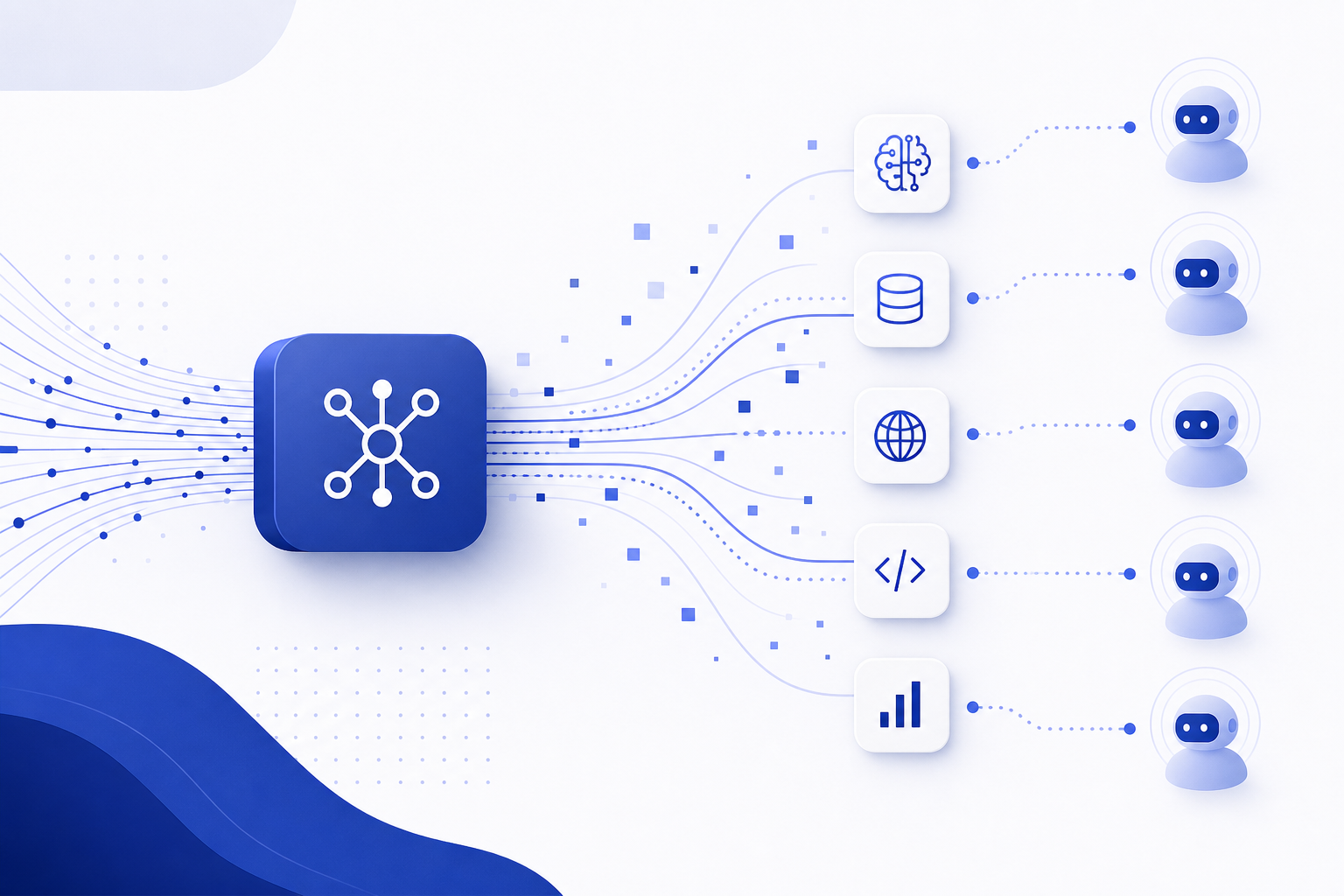
If that sentence sounds like alphabet soup, here is the plain version. MCP is the standard 'plug' that lets AI assistants like Claude, ChatGPT, and Gemini connect to outside tools: your calendar, your database, your CRM, your files. Until now, every MCP connection required a handshake and a persistent session, like a phone call that has to stay connected the whole time. The 2026-07-28 update turns that phone call into something more like text messages: each request stands on its own, no open line required.
This matters because the old session-based design was the single biggest headache for companies trying to run MCP servers at scale. The new stateless design lets agent infrastructure work like the rest of the web: cacheable, routable, and easy to distribute across ordinary servers.
🔌 A 60-Second Primer: What Is MCP, Really?
Think of MCP as USB-C for AI. Before USB-C, every device needed its own charger. Before MCP, every AI tool integration needed custom code. Anthropic open-sourced MCP in late 2024, and within a year OpenAI, Google, and Microsoft had all adopted it. Today, when you connect Claude to your Google Drive or hook Gemini into a company database, MCP is often the standard doing the work behind the scenes.
The 'stateless' part is the new bit. The original spec required an 'initialize' handshake and pinned each session to a specific server instance using a session ID header. In human terms: the server had to remember who you were between messages, which meant companies needed special infrastructure (sticky sessions, shared session stores) just to keep conversations from breaking.
Stateless means the server no longer needs to remember. Every request carries everything it needs. Any server in a fleet can answer any request, which is exactly how the normal web has worked for decades.
Why 'stateless' is a compliment, not an insult
In engineering, stateless is a feature. Stateless services are cheaper to host, trivial to scale horizontally, and easier to monitor with standard tools like OpenTelemetry. The entire modern web runs on stateless HTTP for this reason. MCP joining that club means AI agents inherit twenty years of proven web infrastructure.
💡 Why It Matters for Solopreneurs and Everyday Users
You are probably not going to host an MCP server this weekend. So why care? Three reasons.
First, cheaper infrastructure flows downstream to you. When running an AI integration no longer requires specialist session management, the cost of offering one drops. Expect more SaaS tools you already use, from accounting apps to email platforms, to ship official MCP connectors, because the barrier to hosting one just fell to 'ordinary web hosting behind a plain load balancer.'
Second, reliability improves. Session-pinned servers fail in annoying ways: your agent loses its connection mid-task and has to start over. Stateless servers can hand your request to any healthy machine, so the agent workflows you rely on (research assistants, inbox triage, report generation) become less fragile.
Third, the ecosystem consolidates around one standard. When Anthropic, Google, OpenAI, and Amazon all align on the same protocol version, the tools you buy today are less likely to be orphaned tomorrow. For a solopreneur betting their workflow on AI agents, that standardization is quiet but valuable insurance.
⚖️ Old MCP vs. New Stateless MCP: Side by Side
Here is the before-and-after in one table. You do not need to memorize it, but skimming it will make every future MCP headline easier to parse.
The short version: the old model behaved like a stateful phone call that one specific server had to keep alive. The new model behaves like standard web traffic that any server can handle.
| Aspect | Old Spec (pre-2026) | New Spec (2026-07-28) |
|---|---|---|
| Connection style | Persistent session with initialize handshake | Independent, self-contained requests |
| Server memory | Session pinned to one server via session ID | No session pinning required |
| Scaling | Sticky sessions and shared session stores | Plain load balancer, ordinary HTTP hosting |
| Hosting cost | Higher, needs specialist infrastructure | Lower, standard web infrastructure |
| Monitoring | Custom tooling | Standard tools like OpenTelemetry |
| Failure recovery | Session loss can break an agent mid-task | Any healthy server can pick up the next request |
🚀 How You Can Act on This Today
You do not need to write code to benefit from this news, but there are concrete moves you can make this week.
If you use AI assistants daily, open the connectors or integrations menu in your tool of choice. Claude (claude.ai) supports MCP-based connectors directly, and models like Claude Sonnet 4.6 are built to work with them. Gemini and ChatGPT have their own connector ecosystems built on the same protocol family. Try connecting one real tool you use, such as Google Drive or your calendar, and give the assistant a task that spans both.
If you run a SaaS product or sell digital services, ask your developer (or your AI coding assistant) one question: 'Can we expose our product as a stateless MCP server under the 2026-07-28 spec?' Being reachable by AI agents is quickly becoming the new 'having an API,' and the stateless update just made it dramatically cheaper to say yes.
If you are simply AI-curious, read the primary sources. The official spec changelog at blog.modelcontextprotocol.io explains the 2026-07-28 release, and coverage from outlets like VentureBeat and New Relic translates it for different audiences.
- ✔Open the connectors menu in Claude, ChatGPT, or Gemini and link one tool you actually use
- ✔Test one cross-tool task, for example: summarize this week's calendar and draft a plan
- ✔If you own a product, ask whether it can ship an MCP connector on the new stateless spec
- ✔Bookmark blog.modelcontextprotocol.io for future spec updates
- ✔Revisit any agent workflow that previously felt flaky; reliability is improving under the new spec
🔭 What Comes Next for AI Agent Infrastructure
The stateless update is infrastructure news, and infrastructure news is always a leading indicator. When the plumbing gets cheap, the products get abundant. The likely next wave: fleets of specialized agents from small teams, since hosting an agent backend now costs about as much as hosting a normal website.
Watch for three signals through late 2026. One, more 'works with your AI assistant' badges on everyday software, powered by MCP connectors. Two, enterprise adoption accelerating, since stateless services pass security and operations reviews far more easily than custom session infrastructure. Three, gateway and observability vendors (the New Relics and cloud providers of the world) shipping first-class MCP support, which is already underway.
For regular users, none of this requires action. It simply means the AI agents you use in 2027 will be faster, cheaper to run, and less likely to drop your task halfway through. That is what good infrastructure news looks like: invisible, and better.
❓ Frequently Asked Questions
What is MCP in AI, in simple terms?
MCP (Model Context Protocol) is an open standard, introduced by Anthropic in November 2024, that lets AI assistants connect to outside tools and data sources like calendars, databases, and file storage. Think of it as USB-C for AI: one standard plug instead of a custom cable for every integration. It is now supported across the industry, including by Google, OpenAI, and Amazon.
What does 'stateless MCP' actually mean?
Under the old spec, an MCP server had to maintain a live session and remember each client between messages, which made scaling hard. Under the 2026-07-28 spec, each request is self-contained, so any server in a fleet can handle it. This makes MCP servers cheaper to host, easier to scale on ordinary web infrastructure, and more reliable when individual machines fail.
Do I need to change anything in how I use Claude, ChatGPT, or Gemini?
No. This is an infrastructure change handled by the companies hosting AI tools and connectors. Your experience should improve passively: expect more available integrations and fewer mid-task connection failures. The only action worth taking is exploring the connectors menu in your AI assistant, since the ecosystem of available tools is about to grow.
Does the stateless update make AI agents less capable of remembering things?
No. Statelessness refers to the network protocol, not the AI's memory. Your assistant still keeps conversation context and any memory features it offers. What changed is that the server plumbing underneath no longer needs to keep a live session open, which is invisible to you as a user.
🏁 Final Thoughts
The MCP stateless updates are the kind of news that sounds technical but quietly shapes what you will be able to do with AI next year. The 2026-07-28 spec removed the biggest scaling bottleneck in agent infrastructure, Google and the major cloud providers are on board, and the practical result is simple: more AI connectors, lower costs, and fewer broken workflows. Try connecting one real tool to your AI assistant this week and see the difference an agent with real context makes. If this explainer saved you a research rabbit hole, subscribe to Agents at Work for plain-English breakdowns of AI news, and drop a comment with the next headline you want decoded.
Last updated: August 06, 2026 · Keyword: MCP stateless updates · Agents at Work


Comments
Post a Comment